
The attendees to the Cambridge Conservation Forum (see previous blog) were divided into seven groups, each of roughly fifteen people, and asked to produce their own ‘story’ of ‘conservation’.


They first defined TODAY and developed a timeline backwards, made up of the most important events, decisions and turning points that have led us into the current situation.
.
.
.
.
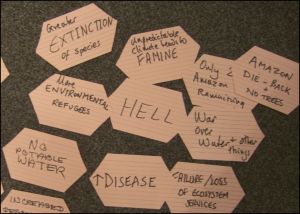
Then if within three years ‘everything that could go wrong did go wrong’ what would HELL look and feel like, and what might be the fictitious events that lead to it.
.
.
.
.
.
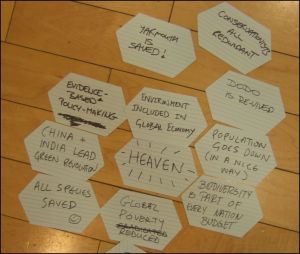
Finally if within three years everything that could go right, did go right, what would HEAVEN look and feel like, and what fictitious events might lead to it.
.
.
.
Each group then nominated a storyteller who told their own story to two other groups.
.

90 minutes in total. 95 participants. 7 Groups. 3 separate rooms. Hundreds of hexagons. 50 David Beckham Sharpie pens. A laminated set of instructions for each group. Two additional facilitators were absolutely essential – Thanks Annie and Pamela. Great fun was had by everyone, lots of potential applications for this and other associated techniques were identified and discussed especially that of ‘Transition Towns’ for which I am hoping to plan and run a pilot very soon. The material was at times deadly serious and thought provoking and I hope from the three example photos shown above you can appreciate the merits of this technique as a ‘weak signal’ detector.
Unusually we managed to make adequate time for an all forum review of the technique and outcomes at which I took immediate advantage to explain the importance of laughter and the associated release of oxytocin in its bonding role. I also explained how any subsequent impact and (prioritised) initiative planning would have had considerable buy-in thanks to the self organising, emergent, sense making from within nature of this (Cognitive Edge) method of facilitation.


 Narrative Ecology - Blog of Ron Donaldson - fACILITATOR, TRAINER AND COACH
Leave a comment