
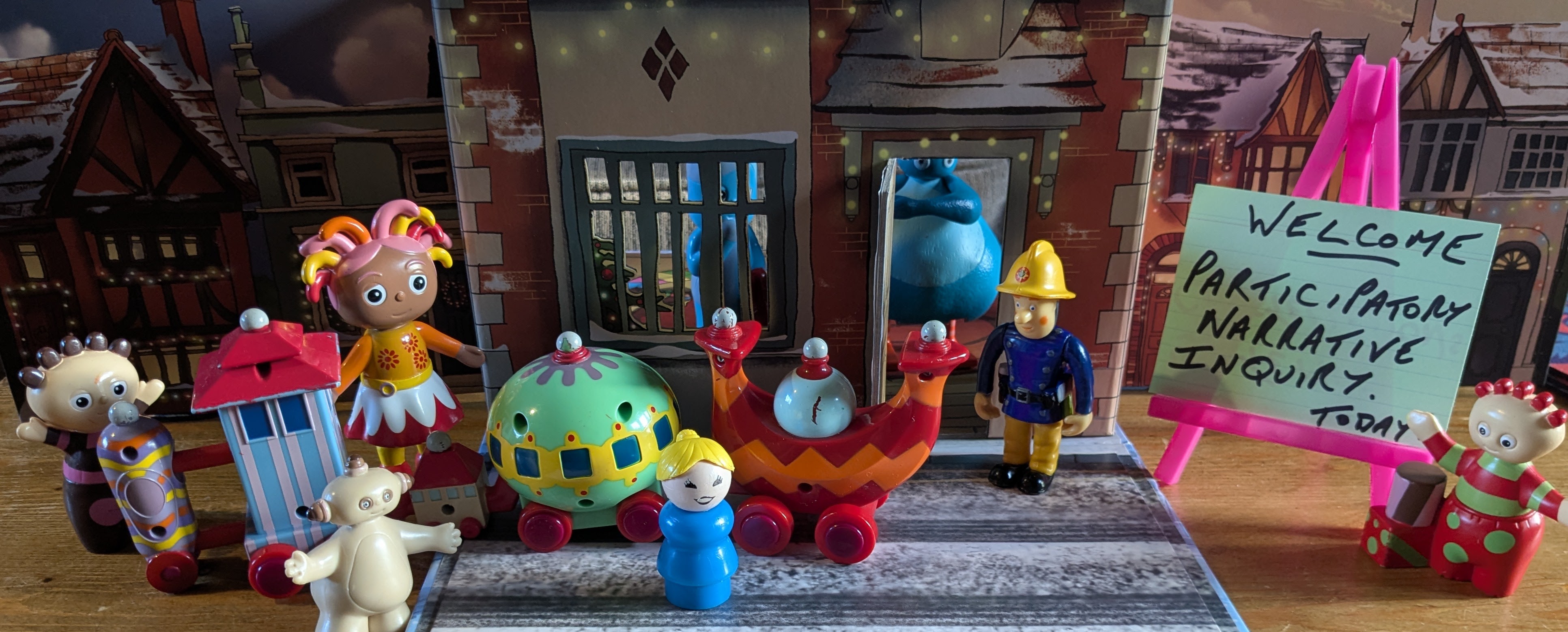
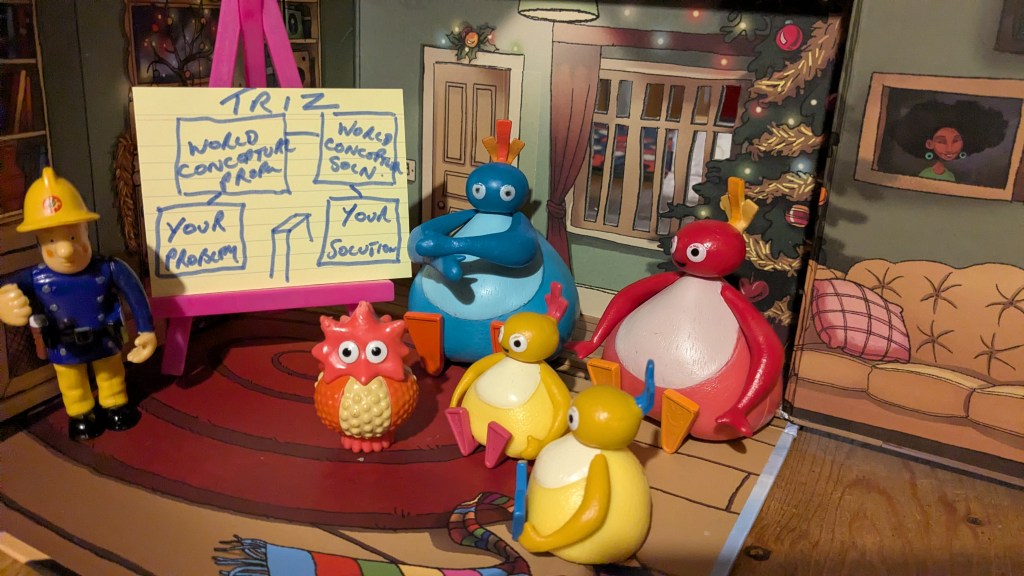
Fireman Sam welcomes everyone to his new side hustle, participatory workshops in the old library in Pontypandy. The group are made up of as many of the different interests as possible so that the stories and ideas are well balanced and cover as much of the territory as possible. note that only one of the Tombliboos was invited as all three would have over dominated the proceedings.
This is part two of twelve posts before Christmas reflecting on the components, tools and principles that I am most interested in, have found most useful, and make up my narrative ecologist identity. PNI (Participatory Narrative Inquiry) is the broad term that covers the largest part of my practice.
One insight I learned from Steve Denning right back at the start during his Springboard storytelling training sessions was to meet and greet everyone as they arrive. Shake hands, look them in the eyes and welcome them. it builds trust and acceptance in you right from the start. I recently started doing this at other peoples events while they struggled to get the technology working, Its the best opportunity to engage and build relationships. The Springboard was my first introduction to how storytelling might inspire and set the scene for organisational change and i still include its basic form in the middle of my workshops.
I have never really known what to call my approach, I am sure my family and friends think I must be a spy. Just yesterday I met an old work friend who asked if I was still doing the old storytelling stuff. I once met the CEO of English Nature on the train and he asked where my feathered hat and lute were. Storytelling means something different to everyone. Key Insight – find a director or senior manager that will support you and watch your back, me and my lute were always at risk. My key sponsor was Caroline, the finance director and without her I would never have lasted six months.
Even though it was a fundamental part of my Cynefin/Cognitive Edge training, I always thought that Cynthia Kurtz had a killer explanation of what it was we were all trying to do. It was PARTICIPATORY in that everyone who attends gets involved, and their voice is encouraged and heard. The heart of the workshop is around NARRATIVE, sharing anecdotes, building timeline stories, telling stories between groups and storyboarding ideas. Finally, the bit I love most, is that the workshop takes the form of an INQUIRY where everyone examines the evidence such that they can make decisions on what they should do next.
I was so proud to be one of the founding partners to create the PNI Insitute with Cynthia. My ‘working with stories’ friend Chris Corrigan who inspired me to get back to blogging, recently did a perfect post appreciating the work Cynthia has done, so I wont try and match his complete picture.
Dave Snowden, Tony Mobbs and Sharron Darwent in the early days used to drum into us that we should keep independent of the subject matter, a complex facilitator as they defined it. I have maintained this principle throughout, even when working with engineers using non complex tools. My favourite line, that I use regularly, is that I can’t give examples for fear of leading the witness. Ambiguous instructions are great.
As for my key insights in using PNI:
After a few workshops I found that I was getting the most encouraging feedback. Several participants said that it had been the best workshop they had ever been to, and some of these were on data management and strategy formation, not the most exciting subject matter. I began to realise that it was the nature of building stories then telling them to each other made participants feel so engaged and that they seemed to embody the whole system by way of knowing the past, present and future and several anecdotes that inhabit this narrative landscape.
Another benefit of producing this story as something scaleable, that people could point at when discussing issues, surprises or similarities with their version of the story was that any criticism was about the story not the teller or person that wrote that hexagon. This greatly reduces any levels of conflict.
I do however remember one awful Team visit in English Nature where one disgruntled member of the team kept adding “Team manager resigns”, “Team manager is sacked for bullying” to the desirable future area. The Team manager was present and just kept quietly removing his vexxy hexxies. It made me realise that they might not all go smoothly. The narrative landcape that emerges is most useful when it contains different perspectives.
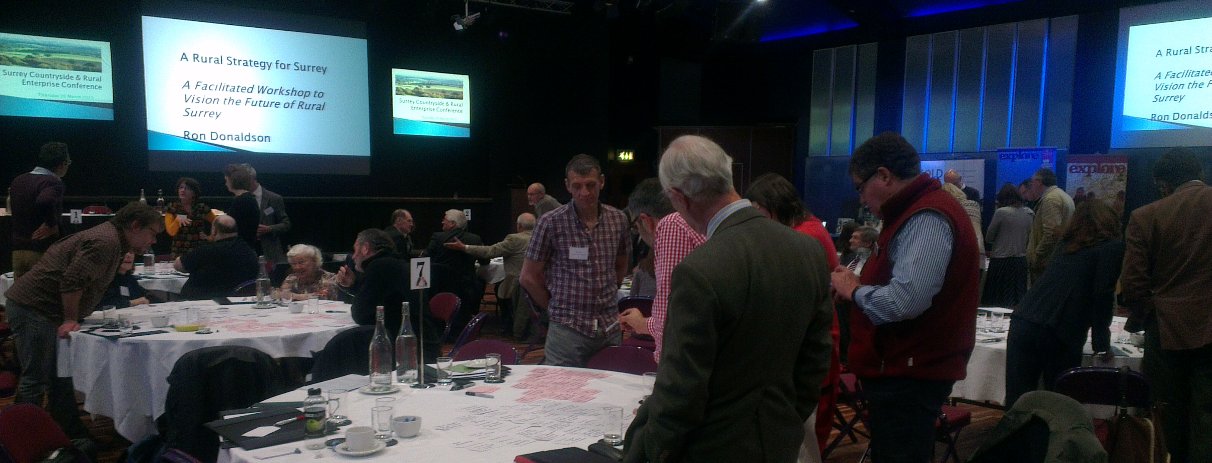
I learned in Woking, at a Surrey Wildlife Trust hosted event, that the approach is almost infinitely scaleable. There were more than 150 people turned up to make decisions on the development of a rural strategy for Surrey. I separated them into about 20 groups and simply explained each set of instructions and ran around telling them all the things i had forgotten. At the end it was planned for 30 minutes round-up. I knew that this would be the most confident, loudest two in the room telling everyone else what to think. So I channeled David Gurteen who runs very varying sized knowledge cafes and asked everyone to pair up with the next group and discuss their thoughts about the session. It worked like a dream. the volume and energy in the room was amazing. At the very end an old lady came over and said “I’ve been to most Council meetings here in the last 40 years and this was by far the best, I was given time to speak and my thoughts were listened to and considered.
The voice that everyone most wants to hear at an event is there own.
I know that leaving them happy should not be the primary outcome for such an event, if it was you should book a clown or comedian, but a happy crowd can be remarkably more cooperative and collaborative. This was one of several workshops I worked with (Hedgie) Jim Jones who was similarly taken by PNI that he now also calls himself a narrative ecologist so there are now two of us to contend with.
Rather appropriately some of my best PNI workshops were focussed on the learning from Public Inquiries when I was still at English Nature. Public Inquiries were expensive and resulted from challenging development of some sort. One of these was the Birling Gap Inquiry looking into whether the residents on the South Coast should be allowed to prevent the sea from eroding the cliffs and threatening their houses. They identified loads of key insights and repeatable lessons which I can’t list here as they might be used against them. The most interesting lesson I can share was that despite the sessions being structured to come to a compromise, I was told by one young participant that almost all the breakthroughs and way giving occurred in the tea breaks, over lunch, walking to the station, never in the formal sessions. This looks like the sessions should be reformatted into social events with a final official session to sign off what was agreed during the nature walks and evening disco.
Post number three should appear on Friday and will look at Affordances.
2026 will be the beginning of the end for me (like the Whitesnake, Who and Elton John retirement tours, the band Europe have even called theirs the Final Countdown) hopefully with a series of workshops with friends and colleagues I have worked with over the years. Please get in touch if you are interested or would like one final workshop or training session.
 Narrative Ecology - Blog of Ron Donaldson - fACILITATOR, TRAINER AND COACH
Leave a comment