
At the end of a workshop the ideal outcome is excitement, motivation and commitment towards the actions identified. My personal (greatly Cognitive Edge influenced) preferred approach to facilitation is to stay out of the context as much as possible.
The thinking behind this is that if the groups self-organise themselves around what they feel passionate about, self-reveal any insights, issues or ideas they might have, and then self-realise the sense to be made around these, then they will avoid the natural reaction to being led towards a pre-conceived outcome, and the ownership of the outputs will be complete.
Or so I thought until now. At a couple of recent workshops I have been left with most, if not all of the interim stage outputs, the piles of future backwards hexagons, the masses of emergent themed anecdote circle material and sheets and sheets of river diagrams, cynefin frameworks and message maps.
I fear that the issue of ownership goes further than the ideas, action planning and sensemaking of the workshop. For true ownership they need to also facilitate the workshop themselves. The process of facilitating a workshop internally gives the total feeling of control, no matter how friendly, involving and professional the external facilitator can be. In hindsight I now remember this feeling acutely when, as I worked in English Nature, we would proudly run participatory narrative workshops and feel a true sense of accomplishment that it was a totally, English Nature outcome. Problems, solutions, actions and facilitation.
There are however (I now genuinely believe) massive benefits from bringing in an independent external facilitator who spends all their time perfecting workshop methods, is alert to the energy levels, involvement issues, alternatives and options at every step of the process, likely session timings, flow of outputs into subsequent activities and many more unpredictable barriers.
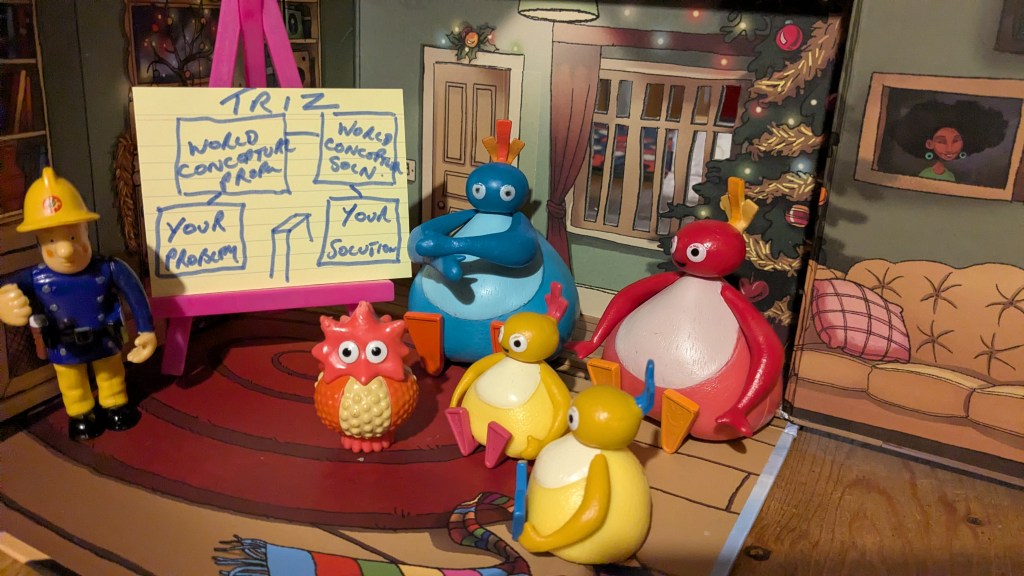
In TRIZ terms this sets up a contradiction. How can a group ‘own’ the facilitation but ‘not own’ the facilitator in order to get the best outcome possible.
I don’t know the answer. In my work with both Oxford Creativity and Argenta Europ, I help develop facilitators via experiential learning with the intent that they will be self-sufficient in their own organisation, but what about the big, expensive, high profile, must succeed challenge or ‘Wicked problem’ that inevitably arises. Then what about the broader, interdisciplinary, merger, conference events where directive facilitation with a potential stake in the outcome, might be disruptive, distrusted and even damaging.
I guess the approach should be appropriate to the challenge and the circumstances and for this I would recommend a good scoping study prior to the event followed by a rigorous double loop lessons learned review afterwards.


 Narrative Ecology - Blog of Ron Donaldson - fACILITATOR, TRAINER AND COACH
Leave a reply to plexity Cancel reply