
I can’t now remember if it was a tweet, a blog post or a newspaper article that got me thinking about this but apologies if I am not recognising someone’s initial jumpstart.
One of the first problem solving tactics in TRIZ (the Theory of Inventive Problem Solving) is that of Trimming. Trimming is an intervention that is well suited to the ordered domains of the cynefin framework ie where cause and effect can be causally linked.
If you trim a complex adaptive system (which by definition “the whole is more than the sum of its parts”) and remove a part, how can you be certain of the implications on the outcome of the ‘whole’.
It is a very natural evolutionary trend for an organisation to concentrate on one product/service and exclude other ideas for change as a threat to the status quo. Then in order to compete, the organisation will trim and trim and trim any spare capacity to adapt.
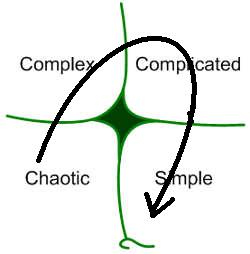
I therefore wonder whether there is a natural tendency/trend from Chaos – Complex – Complicated – Simple, which of course is a full clockwise circle of the cynefin framework.
As the incremental trimming changes reduce the process steps, component parts, time to market, cost, etc you can see why what is left drifts slowly towards the simple-chaotic boundary as there is little capacity left to adapt and little appetite for innovative change.
Having recently returned from a nostalgic rock and blues festival, it was fascinating to see how many bands that have managed to survive up to 40 years on the road, yet are still reliant on and playing major tracks from their first and second albums. Why is it that these early tracks endure but despite universal improvements in musicianship, technology and production. It is quite rare that any of the songs written after those first few albums have any staying power.
I suspect it is the clockwise innovation path through the cynefin domains mentioned above.
When a band first starts up all the members are just getting to know each other, eager to impress and the boundary constraints are few. Different styles of musical influences are blended [A recent documentary on Sky Arts 1 commended Bill Ward of Black Sabbath for his jazz influenced drumming]. Songs are co-written.
Then after many gigs and a couple of albums, egos become inflated, a style is developed, the band is categorised by the music press and there are worries about losing their audience. These constraints inhibit an acceptance of change and diversity.
Fights break out over royalties. Individuals strive to have sole rights to their songs. New members are recruited as jobbing musicians to fill gaps left by feuding members. Increasing drug use, alcohol abuse and tag-along partners inhibits the creative process.
Finally the band are in a simple state doing occasional greatest hits shows for their original and declining, now middle aged, fans with just the drummer as an original member.
This clockwise evolutionary pathway may be more common than we think.



 Narrative Ecology - Blog of Ron Donaldson - fACILITATOR, TRAINER AND COACH
Leave a reply to Cynthia Kurtz Cancel reply