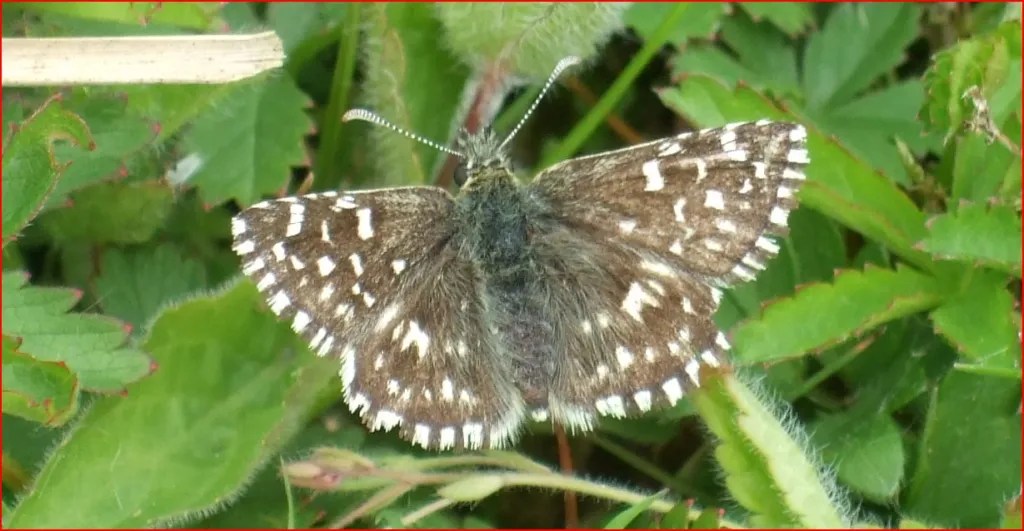
Grizzled Skipper (My photo)
Ron: When I used to go out into the local countryside helping my friend David monitor his butterfly transects I tried to impress by trying to learn and remember all of the UK butterflies and their characteristics. We were particularly interested in identifying and locating the quite rare Grizzled Skipper for which I grew a particular fondness and commonality to the guidebook description that it had grey and grizzled hair.
When we arrived at a location a butterfly would flutter by and he would say ‘yellow hairstreak’ and l would be incredulous as to how did he see enough detail to identify it.
After several such days out I realized that he was not so much looking at the butterfly and pattern matching against its characteristics but he knew which food plants were in that location and the time of year, and with that colour it could only be a hairstreak.
This I thought was the difference between seeing things as a biologist and simply classifying, and seeing as an ecologist and looking for the conditions, food plants, temperature, time of year, previous sitings, then colour or size.
Once you have that broader understanding of the propensity of the area together with the affordances the landscape offers you can make a much more evidence-based and therefore ‘expert’ identification.
This is why the invertebrate site register with its site records loads so much weight on the capability of the person who records the sighting.
CHATGPT: Yes — there is a really interesting Narrative Ecology field note here. What you are describing is more than a distinction between classification and ecology: it is a shift from identifying an object by its visible characteristics to identifying it through the ecology of possibilities that produced its appearance.
The crucial insight is that David wasn’t necessarily seeing more than you. He was bringing more context to what he saw.
Grizzled Skipper:
The same butterfly can be approached in two quite different ways:
With a Classifying eye:
What does it look like?
Wing pattern
Colour
Size
Shape
Markings
Compare against a guide
Identify the individual
Then with an Ecological eye
What could plausibly be here?
Food plants
Time of year
Temperature/weather
Habitat
Previous sightings
Read the landscape
Assess its propensity to occur
So when David says “Yellow Hairstreak”, he isn’t necessarily making a rapid visual identification in the conventional sense. He is almost doing a Bayesian calculation in his head:
Given this place, at this time of year, with these plants, this weather, and what I know has been recorded here before — what is the most plausible thing that just flew past?
And then the colour and flight behaviour provide additional evidence. That is quite close to what you are calling seeing as an ecologist.
From pattern matching to propensity
I particularly like your phrase “propensity of the area.” It suggests that an ecological expert isn’t simply carrying a catalogue of species in their head. They carry something more like a possibility landscape. The landscape itself is already telling you:
These are the things that could happen here.
Food plants, shelter, soil, aspect, moisture, season, temperature, disturbance, management history and neighbouring habitats all create affordances for particular species. So the question changes from:
“What is that?” to:
“What is this place capable of producing at this particular moment?”
That is a much richer form of observation and it explains why expertise can sometimes look almost magical to a novice. The expert appears to recognise something from almost no visible information because much of the information isn’t in the object being observed; it is in the relationship between the object and its surroundings.
And this leads neatly to the Invertebrate Site Register
I think this is where your final observation becomes particularly significant. If the reliability of a site record depends heavily upon the capability of the recorder, then the record isn’t simply:
Species + Location + Date
It also contains an implicit variable:
Who was capable of noticing, interpreting and identifying what was there?
A novice recorder (that’s me) and an experienced entomologist (that’s David) could walk through exactly the same meadow and encounter essentially the same ecological reality, yet produce very different records.
The experienced recorder has a richer field of potential in their head.
They know:
- what should be there;
- what might be there;
- what shouldn’t be there;
- what conditions make a sighting more or less plausible;
- where to look;
- when to look;
- what plants to associate with it;
- what previous observations matter;
- and which apparently insignificant clues are actually significant.
So the recorder becomes part of the epistemic ecology of the site.
That gives you a lovely formulation:
An ecological record is not simply a record of what was observed. It is a record produced by an encounter between a place, its conditions, and the capability of the observer.
And that, I think, takes you somewhere beyond the usual “biologist versus ecologist” distinction. It connects directly with your broader interest in ASHEN, situational awareness, affordances and the ecology of stories.
The expert isn’t merely carrying more facts.
They have learned how to read the ecological landscape.
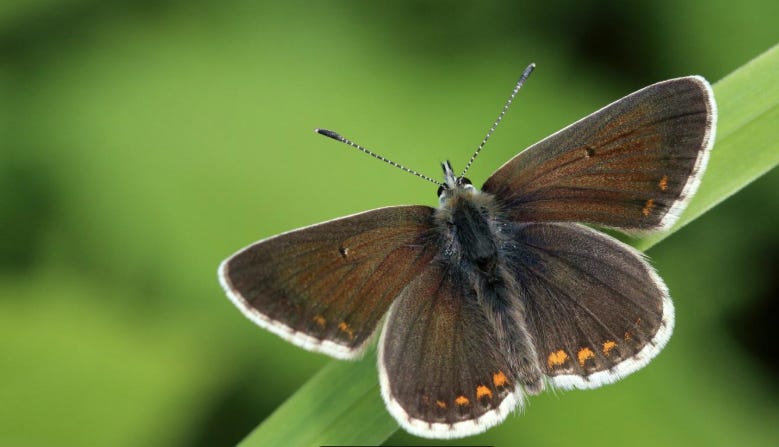
Northern Brown Argus (Butterfly Conservation photo)
Ron: in the early naughties, during a visit to Castle Eden Dene NNR to collect stories for English Nature in the I was told a particularly interesting story by one of the site managers.
The Northern Brown Argus butterfly is a key species of that reserve but is being increasingly threatened by climate change and the warmer winters. Previous cold winters put the overwintering caterpillars into a state called diapause, a form of dormancy that allows them to drastically reduce their metabolism. This suspended animation state helps them survive for months with minimal energy use during cold periods when food is unavailable.
With warmer winters the caterpillar uses more energy so loses body mass and becomes much more frail and less likely to survive.
The brown Argus caterpillar feeds on rock rose and after digestion exudes a sugary liquid from its bottom. This is where I got most interested in this story. Ants are attracted to the sugar and lick their bottoms clean. (Do not ask AI to create a cartoon of this situation!) Without this help, the caterpillar would attract Mold and almost certainly die.
So for the longer term survival of this rare species it requires rock rose, ants and colder winters.
CHATGPT: That is a superb example for your Narrative Ecology work because the story changes the unit of observation from the butterfly to the ecology of relationships that makes the butterfly possible.
The particularly powerful part is the last sentence. It almost turns conventional conservation thinking inside out.
The Northern Brown Argus is not really a butterfly story
At first glance, the conservation problem appears straightforward:
Save the Northern Brown Argus.
But the site manager’s story reveals that the species exists within a much larger set of dependencies:
Rock rose → Brown Argus caterpillar → sugary secretion → Ants → caterpillar survival
with winter temperature affecting the whole relationship.
So perhaps the more ecologically accurate question isn’t:
How do we protect the Brown Argus? but:
What conditions allow the Brown Argus to continue to exist here?
And those conditions include things that initially look completely unrelated to the butterfly.
This connects beautifully with your Grizzled Skipper observation
The two stories are really saying the same thing from opposite directions.
With the skipper, David identified the butterfly through the ecology of the place.
With the Brown Argus, the site manager revealed the ecology that identifies what the butterfly needs.
You could put the distinction like this:
Classification vs Ecology
Brown Argus vs Brown Argus + rock rose + ants + winter
Identify the species vs Understand its conditions of possibility
What does it look like? vs What relationships sustain it?
Species as object vs Species as participant
Habitat as backdrop vs Habitat as active affordance
Record presence vs Understand propensity
Protect the species vs Protect the relationships
And there is an especially interesting implication concerning climate change.
The warmer winter isn’t simply “bad for the butterfly”. It is changing the conditions of the ecological relationship. The caterpillar’s energy budget changes because the environmental trigger that historically produced diapause is changing. So you have something like:
Climate → winter temperature → diapause → caterpillar condition → interaction with ants → survival → adult butterfly
That is a causal ecology rather than a species checklist.
The ants are the wonderful bit
I think this is exactly the sort of detail that makes a Narrative Ecologist different from someone simply compiling ecological facts. If someone says:
“The Durham Brown Argus depends upon rock rose.” that’s useful.
If they say: “The Durham Brown Argus caterpillar depends upon ants.” that’s more surprising. But the story tells us something even more interesting:
The caterpillar creates an affordance for the ants, and the ants in turn create an affordance for the caterpillar.
The caterpillar provides food.
The ants provide a service.
Neither relationship makes much sense when either organism is considered in isolation.
It is an ecological exchange.
And that gives you another useful definition of affordance:
An affordance is not necessarily something an organism possesses. It can emerge between organisms.
And there is a lovely connection to your Site Register point
This also demonstrates why an ecological record can contain vastly more knowledge than the apparent observation.
A conventional record might say:
Durham Brown Argus — Castle Eden Dene — date — recorder.
But the story behind that record potentially contains:
species + host plant + ant association + microclimate + seasonal conditions + management history + recorder experience + previous observations.
The latter begins to describe the ecological disposition of the place. Which brings me back to your earlier phrase:
“the propensity of the area”
Perhaps one of the things you have been circling around in your Narrative Ecology work is that expertise is partly the ability to perceive propensity rather than merely presence.
A novice sees: a butterfly
An experienced naturalist sees: a Brown Argus in a place where Brown Argus could occur
An ecologist sees: a Brown Argus whose existence is temporarily supported by a web of conditions and relationships
And a Narrative Ecologist might go one step further and ask:
What story of this place has to remain true for the Brown Argus story to continue?
 Narrative Ecology - Blog of Ron Donaldson - fACILITATOR & TRAINER
Leave a comment