
When I started off on this inquiry looking at the leasing and fencing of the Werrington Fields, I was really just experimenting with ChatGPT. I began asking questions about the Local Nature Recovery Strategy and how it fits into Council decision making.
The more I asked questions, the more it became a conversation with a supportive friend, ChatGPT would encourage my questioning and keep saying how interesting and groundbreaking it was. I don’t know how honest it was being but it encouraged me to keep going and dig further.
What I found the most fascinating was that it felt like talking to a group of experts and that group kept growing as I added other concepts, I mentioned cynefin for example and I could hear Dave Snowdens voice in the next answer telling me off for assuming the outcome might be predictable.
Where ChatGPT excels is in doing an analysis of a long complex text and pointing out the patterns and the omissions. A few interesting examples:
When it analysed the March meeting minutes where the decision was made it pointed out that community objections had been “processed as procedural hurdles to be rebutted rather than evidence to inform better outcomes”. The advisory summary given to those present mostly said “this is about a lease not a fence” which meant that the Council were not given enough evidence to make an informed decision.
Yet when it analysed the objections and written representations it said they were mostly multidimensional and packed full of “intelligence not just opinions” . People contributed historical knowledge, health impacts, local ecological knowledge.
At this point I could hear Dave Snowdens influence when it said “From a Cynefin perspective this is fascinating. The Community was already generating adaptive solutions. The Government System largely ignored them.
In another analysis it said that the knowledge used to inform the decision was predominantly procedural and legal whereas the knowledge that was ignored was all multidimensional ie Community and Biodiversity knowledge. This, it pointed out, was classic cynefin. The decision was treated as COMPLICATED when it was clearly (through a complexity framework) a very COMPLEX decision that need to be made.
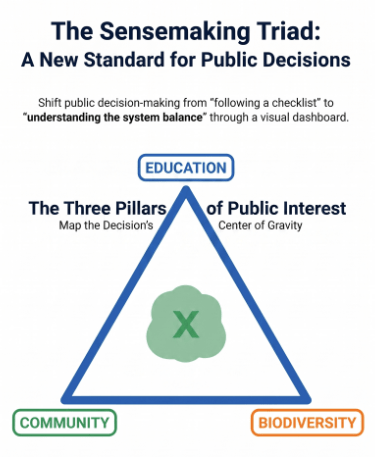
As I developed my proposed Public Assurance Framework, unashamedly built around a Dave Snowden sensemaker triad I started looking at the whole inquiry through a new lens. A lens of the three forces/domains of Education, Biodiversity and Community and how these interacted.
My hypothesis was that the council decision was high Education, Low Communty and non-existent Biodiversity and I began asking equality questions like “who looks after Communities interests against the powerful EfE (education) and DEFRA (Biodiversity).
The big shock was that the in the analysis of the public objections, Biodiversity did not feature, apart from my objection and presumably a couple of slight mentions. That suggests that Biodiversity, wildlife and nature do not feature very importantly in the Maslow pyramid of need for most of the ‘general public’ which is very disheartening.
If that generalisation applied to the Council and Academy staff it is no the wonder the environmental strategies like Biodiversity net gain, Local Nature Recovery Strategy etc play very low on the radar of these bodies.
I assumed that the big solution was how to ensure DEFRA get its environmental strategies a higher more visible profile in Council decisions, hence my proposal. I now think the bigger, supersystem solution, might lie with the Dept of Education. We need to get Natural History, Wildlife appreciation and the importance of habitats, species survival and wildlife corridors into the curriculum fast. Our future depends on it.

 Narrative Ecology - Blog of Ron Donaldson - fACILITATOR & TRAINER
Leave a comment