Reframing Future Backwards through the ecology of influence.
Austin Kleon, in his book Steal Like an Artist, offers an interesting challenge to the way we think about influence.
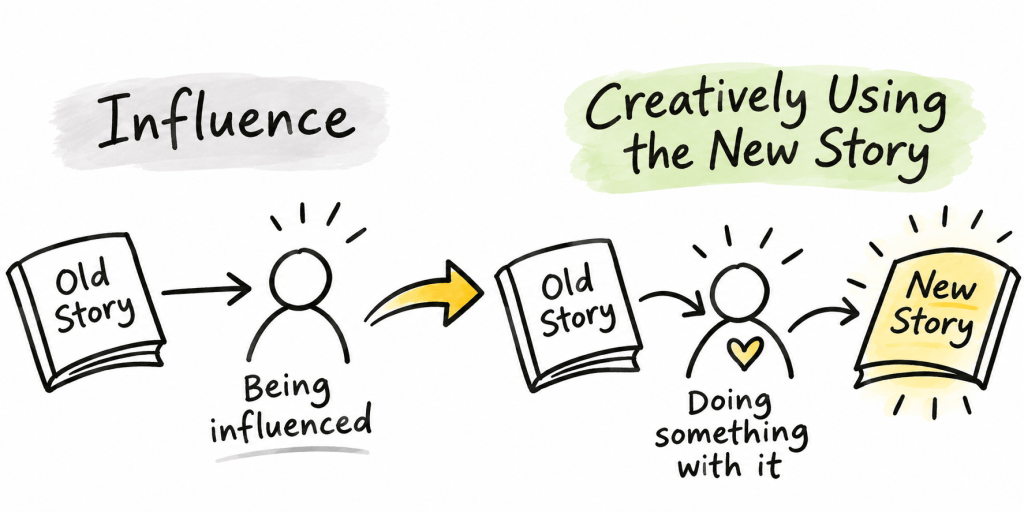
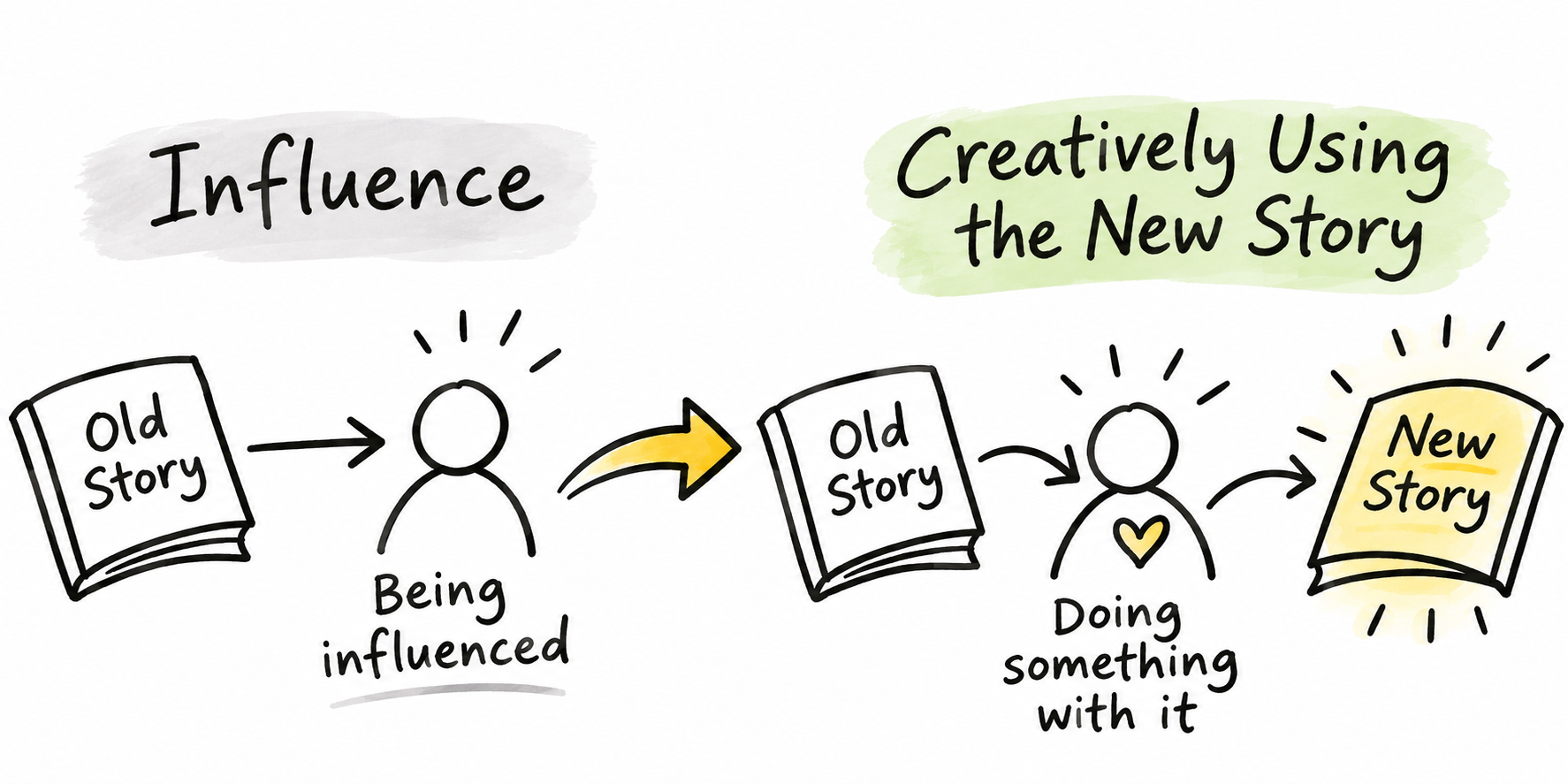
He suggests that our understanding of influence is backwards. When we say that Basquiat was influenced by Van Gogh, we imply that Van Gogh did something to Basquiat. But perhaps the more important action was what Basquiat did with Van Gogh.
As critic K. K. Ruthven observes:
“Our understanding of [influence] is obstructed by the grammar of our language.”
And Basquiat puts it rather beautifully:
“You’ve got to realize that influence is not influence. It’s simply someone’s idea going through my new mind.”
This is more than an observation about artistic creativity. It offers a different way of thinking about how people, communities and organisations learn, change and make sense of their experiences.
The past is material, not instruction
We often talk about the past as though it has a determining influence on the present. We inherit circumstances, decisions, experiences, traditions and stories. They are assumed to have shaped who we are and how we behave.
But this is only part of the story.
The past doesn’t arrive in the present with its meaning intact. We reconstruct it. We select from it, interpret it, connect previously unrelated events and give experiences new significance.
Two people can experience exactly the same event and take entirely different things from it. Equally, the same person can revisit an experience years later and discover something they couldn’t previously see.
The experience hasn’t changed. The mind receiving it has.
This is where learning actually happens: not simply through exposure to experience, but through the active work of exaptation.
We take something from an experience, detach it from its original circumstances, recognise a pattern, and consider what that pattern might mean somewhere else.
We don’t simply inherit the past. We make something with it.
Future Backwards: turning influence into action
The Future Backwards method provides an interesting setting for exploring this idea.
At first glance, the method appears to be about constructing a narrative of how we arrived at the present and imagining the possible futures that lie ahead.
We explore:
- The present: Where are we now?
- The past: What happened to bring us here?
- The negative future: What might happen if things go badly?
- The positive future: What would a desirable future look like?
- The narrative journeys: What stories connect these different landscapes?
But there is a subtle danger.
We can become so absorbed in reconstructing the past that we treat it as an explanation rather than an opportunity for learning. We identify the events, decisions and circumstances that brought us here, but fail to do the more difficult work of extracting what they might teach us.
We become historians of our own experience rather than active participants in making sense of it.
Kleon’s idea suggests a different orientation.
The question isn’t simply:
What influenced us to get here?
It is:
What can we now do with what we have experienced?
That requires an active process of exaptation. We need to step away from the detail of individual stories and ask what sits beneath them.
What patterns are becoming visible? What assumptions have been challenged? What did we learn that we didn’t know we were learning at the time? What capabilities, relationships or affordances emerged unexpectedly? What would we do differently if we encountered similar circumstances again?
This is where the past becomes useful to the future.
The missing movement: from experience to exaptation to action
There is a movement in learning that is easily overlooked.
We experience something. We tell stories about it. We make sense of those stories. But unless we actively extract and reinterpret what we have learned, the experience can remain trapped in its original context.
Exaptation allows us to release that learning. Dave Snowden’s work actually makes the distinction particularly relevant. The Cynefin definition describes exaptation as taking an idea, tool, method or capability developed for one purpose and using it for another. He also calls it radical repurposing.
For example, a community might tell stories about a successful local initiative. The obvious temptation is to reproduce the initiative elsewhere.
But perhaps the real learning isn’t the initiative itself.
Perhaps it was the unexpected relationship between two groups, the emergence of trust, the removal of a particular barrier, or an invitation to participate that nobody had previously recognised.
These are different kinds of learning. They can be carried into new circumstances, where they might produce something quite different.
The original experience becomes a source of possibility rather than a template for replication.
I see this as an important distinction in Narrative Ecology.
We aren’t trying to reproduce stories. We are trying to release the potential contained within them.
A different relationship with time
This also changes how we understand progress.
We tend to imagine progress as a sequence of events: something happens, we learn from it, we move forward.
But change is rarely that straightforward. We continually reinterpret what has happened in the light of where we find ourselves now and what we hope might happen next.
The present is therefore more than a point between past and future. It is an active place of interpretation.
We look backwards from where we are today and discover things about our history that we couldn’t previously recognise. We look forwards towards a desirable future and that imagined future changes what we notice about the present.
There is a continual movement between the three.
The future changes the questions we ask of the past. The past provides material for making sense of the present. The present provides the opportunity to act differently.
This is why Future Backwards is so valuable when it becomes more than a narrative mapping exercise.
It can become a process of changing our relationship with experience.
From influence to affordance
There is another connection here with the idea of affordances.
An affordance is an invitation or opportunity for action that emerges through the relationship between an individual and their environment.
Perhaps stories work in a similar way.
A story doesn’t carry a fixed lesson that is simply transferred from one person to another. It offers possibilities for interpretation and action.
Different people encounter the same story and see different opportunities. Their experience, knowledge, circumstances and intentions determine what becomes meaningful.
The story is not doing something to them. They are doing something with the story.
And when a community shares and explores those interpretations, something else can emerge: a collective understanding that wasn’t necessarily present in any one individual’s original experience.
This is an ecology of influence. Ideas move, mutate, combine and find new expression through the people and circumstances that receive them.
The practical implication
Perhaps we should add another deliberate movement to Future Backwards.
Not just reconstructing the past, but actively harvesting its learning.
After exploring the past and present, pause and ask:
- What have we discovered? What is now visible that wasn’t visible before?
- What can we abstract or exapt? Which principles, patterns, relationships or insights might have relevance beyond the original story?
- What have we changed our minds about? Which assumptions or beliefs no longer hold?
- What might we do differently? How could this learning influence our choices and actions?
- What new possibilities does this create? What can we now see or do that wasn’t previously apparent?
The final question is particularly important. It moves us beyond reflection into the possibility landscape.
We are no longer simply looking at what happened. We are using what happened to change what might happen next.
A final thought
Kleon’s observation has made me think that perhaps influence is the wrong word when we talk about learning from experience.
Influence suggests something travelling in one direction, from past to present, from one person to another, from one idea to the next.
But learning is much more active and ecological than that.
We receive stories, experiences and ideas, but we don’t simply absorb them. We reinterpret them through our own experience, connect them with other things we know, and sometimes create something that neither the original storyteller nor the original experience could have anticipated.
Basquiat didn’t become Van Gogh. He became Basquiat through what he did with Van Gogh.
And perhaps the same is true of communities and organisations.
The past doesn’t determine our future. What we choose to do with what we have learned from the past helps create it.
Future Backwards isn’t just about understanding how we got here. It is about developing the capacity to do something different with what we now know.
That is the difference between being influenced by our history and actively learning from it.
And perhaps that is where progress begins.
One additional thought
I think there is a potentially useful methodological distinction here that could become part of my Future Backwards practice:
Recalling – Experience – What happened?
Narrating – How do we make sense of what happened? What stories explain our journey?
Sensemaking – What patterns and capabilities can we recognise?
Exapting – What can we take from that experience? What else could we do with what we have discovered?
Recombining – What happens when we connect that learning with other knowledge?
Acting – What might we now do differently?
Emergence – What new possibilities or behaviours might develop?
The particularly important transition is from narrating to exapting.
That is where experience becomes transferable learning, and where the past starts contributing to the possibility of a different future.
We don’t simply abstract lessons from the past to inform the future. We look for opportunities to exapt what we have discovered: taking existing ideas, experiences, relationships and capabilities and finding new uses for them in circumstances we could not previously imagine.
The past becomes a resource for creating something that didn’t exist before.
Stories are not containers of lessons to be passed on. They are resources that people can exapt to create new possibilities.


Leave a Reply