Fences and Boundaries
What follows is a story I uncovered in my work around 2004 while looking for stories about the unusual aspects of working for English Nature. I had offered to help with preparations for the 20th Anniversary celebration of the Aston Rowant National Nature reserve being designated and to collect some stories as part of an ‘oral history’ of the site.
The Story
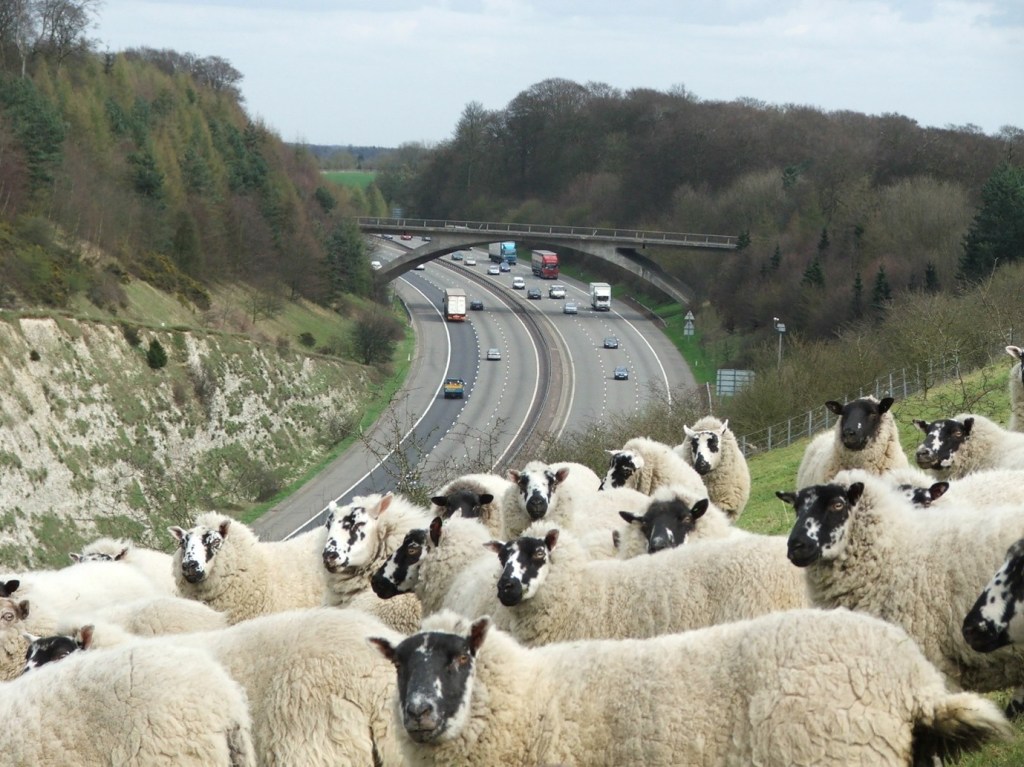
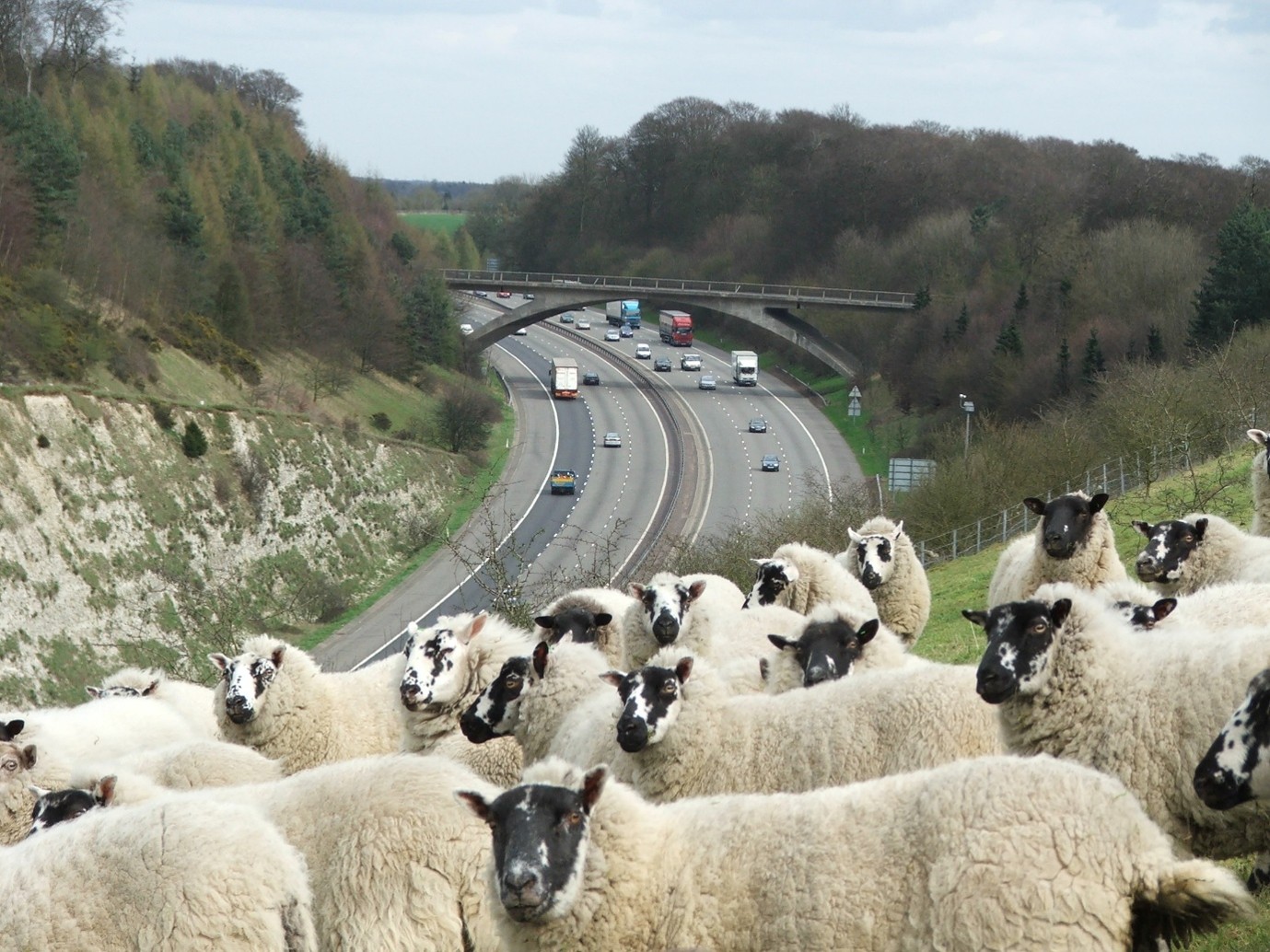
Dominic joined English Nature as assistant site manager at Aston Rowant NNR perched high on the Chilterns in September 2003. The reserve was controversially divided in two by a cutting for the M40 in 1974 as can be seen in my photo above. He had previous experience of volunteering at Holkham and working on community-based project work with the RSPB.
Along with existing member of staff Rachel and some useful advice and guidance from Judith they embarked on a ‘transferable skills’ project getting prisoners to carry out fencing work at Barton Hills.
This project failed mainly due to the distance between prison and reserve and an unfortunate experience with poorly cooked baked potatoes and although Dominic learned that you have to be very thick skinned, Rachel was less keen and recommended no further involvement.
Rachel left English Nature at the end of 2003 and Dominic decided to give it another try. Aston Rowant NNR had a prison nearby, so he approached them to gauge interest.
He quickly made a lucky connection with his initial contact and went to an open day at the prison to discuss his ideas. He then however found that he had to really badger and pester the prison staff to maintain their interest.
As a result, he soon had teams of supervised prisoners working on the reserve and learned that:
· personal qualities of being flexible and patient were crucial
· prisoners particularly liked working with livestock especially the resident sheep.
· providing lunch was particularly appreciated
As Dominic says, “with a relatively small amount of my time setting this up I can now get a team of four men scrub clearing, fully supervised and achieve a whole lot more”.
Following a few meetings with the Governors and prison training manager, he has now set up a certification scheme identical to that which EN staff do on bush cutting and tool handling.
This means that the prison training manager is qualified to train and certify prisoners, which will not only allow them to work unsupervised, but give them a very transferable practical qualification for when they are released and open up opportunities in land management and on other reserves.
The real tipping point in the success of this project was when one prisoner, let’s call him Jimmy, asked if he could bring his family to visit him on the reserve, as it was a much nicer environment for his wife and children, to proudly show them the work he had been doing. He really loved shepherding the sheep to impress his two young children.
A really unexpected benefit emerged from another prisoner’s suggestion that they could take the juniper seedlings and bring them on in the prison greenhouses. This has developed into a full horticultural service for the reserve including the building of dormice boxes and benches which can all be done back at the prison.
Wouldn’t it be great if we could develop these links between prison and reserve further, broadening it out into the wider countryside, building on the ‘within prison’ horticultural and ‘reserve furniture’ services together with further NVQ qualifications. We could then provide this as a template, almost a franchise, to pass on to other prisons, nature reserves and other conservation bodies across the country.
The Sense Making
I told this story at many conferences and events because I knew it contains much more than an interesting anecdote about English Nature. In hindsight it demonstrates several of the ideas I have been exploring recently: affordances, unexpected connections, stigmergy, counterfactual boundaries, narrative, and the creation of capability rather than simply delivery of a task.
What is particularly striking is that the ostensible project was “get prisoners to do fencing.” But that wasn’t actually where the value ended up.
The story has a beautiful generative structure. It seems to unfold through a sequence of increasingly unexpected affordances:
Fencing → scrub clearance → skills certification → employment-quality qualifications → families visiting → prisoners growing juniper → prison horticulture → reserve furniture → countryside service → transferable model
At each step, something that was created by the previous action becomes an affordance for the next action.
That’s very close to the idea of stigmergy I explored in the previous field note: the intervention leaves a trace in the system, and that trace changes what becomes possible next.
The crucial thing is that Dominic didn’t design the final system.
He created the conditions for something to happen and then noticed what emerged.
The really interesting bit: the boundary dissolved
Initially there are two apparently separate ecosystems:
The open Prison (It was not a high security prison, the prisoners had previously done many different jobs in the community) and the National Nature Reserve, with very little obvious reason for them to interact.
The normal institutional response might be:
Prisoners belong in prisons. Conservation workers belong on reserves.
Dominic’s intervention creates a small connection between them and once the connection exists, the boundary becomes permeable. The prisoners don’t just become labour for the reserve. They become:
- skilled conservation workers
- trained horticulturalists
- growers of native plants
- makers of habitat infrastructure
- ambassadors to their families
- potentially contributors to the wider countryside
And the prison itself changes from being merely a source of supervised labour into a production and learning environment.
That is quite a profound transformation for the ‘Social good’
And the best line in the whole story may be this:
“The real tipping point … was when the prisoners began to bring their families to visit the site to show them the work they had been doing.”
Because suddenly the intervention has escaped its original boundary. The reserve isn’t simply benefiting from prisoners. The prisoners have acquired a reason to be proud of their contribution to the reserve and that changes the relationship between prisoner, family, prison and landscape.
The original idea had been to find people to do some fencing. What emerged was a connection between two systems that had previously had almost no reason to interact and once connected, each discovered capabilities in the other that neither had previously seen.
There is a powerful question hiding inside this story It isn’t:
“How can we get prisoners to help nature reserves?”
It is: “What becomes possible when two systems that normally have no reason to interact are deliberately connected?”
We could abstract Dominic’s move into a reusable provocation:
“Who have we mistaken for a resource rather than a partner?”
Or perhaps even more provocatively:
“What capability exists on the other side of the boundary?”
Because Dominic initially saw prisoners as a potential workforce but the prisoners eventually revealed themselves to be something much richer:
a workforce + learners + growers + makers + ambassadors + connectors.
And there is a lovely TRIZZY lesson here
Dominic didn’t solve the problem by finding a better way of transporting prisoners to the reserve. He/they eventually separated the activities in space.
Some things happened on the reserve:
- scrub clearance
- fencing
- livestock work
Other things happened inside the prison:
- horticulture
- propagation
- making boxes
- making reserve furniture
- training
That’s almost a textbook example of separation in space.
But there’s another TRIZ move hiding underneath it: Don’t make the constraint disappear. Make it useful. The prison wasn’t merely a constraint on getting people to the reserve. Its greenhouses, workshops, training infrastructure and staff became assets in their own right. That is a much more interesting form of innovation.
And perhaps the deepest lesson
The project succeeded not because Dominic had a brilliant plan. It succeeded because he was prepared to:
try → fail → try again → connect → observe → notice → respond → expand.
In other words:
Probe → Sense → Respond → Repeat
The juniper is almost the perfect symbol for it.
Nobody planned the prison nursery. Someone noticed an affordance. They acted on it. That action created another affordance. And so the ecosystem began to grow its own possibilities.
That, to me, is the real story of Dominic and the prisoners.
A sad postscript to this story that I have always added in my talks is that despite my aspirations for a franchise opportunity for other prisons linking with other National Nature Reserves the whole engagement enterprise was held together by Dominic. When Dominic moved on, and no-one else was willing to take that extra step to do something outside their normal responsibilities, the project dried up and, to my knowledge, has never been repeated as successfully.
However… I have just asked ChatGPT if it knows of any similar projects and excitingly this is its response:
In fact, this 2003–04 English Nature story appears to have been part of a much larger and surprisingly persistent movement, although the later examples vary considerably in form.
1. HMP Kirkham → Ribble Estuary NNR
This is probably the closest parallel to Dominic’s story.
The Forest Research review of the early Offenders and Nature programmes records that Natural England operated a scheme at Ribble Estuary National Nature Reserve, involving inmates from HMP Kirkham. Prisoners worked on conservation-related activities associated with brownfield land within the prison.
2. Haverigg Prison → countryside conservation in Cumbria
This is probably the most significant later development.
The Forestry Commission’s Offenders and Nature evaluation describes a partnership involving HMP Haverigg, Natural England, the National Trust and the Forestry Commission. Prisoners undertook conservation and forestry work at different sites, all within about an hour’s travel of the prison. Forest Research
There is an especially intriguing modern echo of Dominic’s juniper nursery idea: Haverigg is now involved in growing trees for Cumbria Wildlife Trust’s Skiddaw Forest restoration project. That feels remarkably close to the trajectory Dominic imagined in 2004: prisoners → horticulture → growing plants → supplying conservation projects.
3. HMP Dartmoor → Forestry Commission
This is another major example, although it is more forest conservation than nature-reserve management. In January 2004, the Forestry Commission began taking prisoners from HMP Dartmoor for voluntary work experience with its Dartmoor field team. The programme developed into a structured resettlement scheme involving:
- practical forest management
- clearing-saw and chainsaw training
- nationally accredited qualifications
- paid work experience
- employment references
- potential employment with the Forestry Commission after release.
By March 2006, nine prisoners had participated, and the evaluation reported that all nine found employment or training within six months of release. The environmental work included more than 7 km of streamside biodiversity improvements.
This is fascinating because it moves Dominic’s concept from:
“prisoners can provide useful labour” towards: “conservation work can be part of a pathway from prison to employment.”
So Dominic’s idea has, in effect, become part of contemporary government thinking about prisons and nature.
But there’s something much more interesting here for this story
I think we should distinguish three generations of the idea:
1. Work party
Prisoners provide supervised labour to conservation organisations
Aston Rowant / Barton Hills
2. Skills & rehabilitation
Conservation becomes a training and employment pathway
Dartmoor / Haverigg
3. Integrated ecology
Prison itself becomes part of the conservation system
Haverigg tree nursery / horticulture
And Dominic’s story contains the seed of all three.
That’s what makes your original account so interesting. The extraordinary thing isn’t that prisoners were used to clear scrub. It’s that, almost accidentally, Dominic discovered something much more powerful:
The prison wasn’t simply a place from which people could be borrowed. It was a place containing land, greenhouses, workshops, skills, people, families and capabilities that could become part of the conservation system.
And that takes us straight back the estuarine mapping idea of Dave Snowden’s, that of challenging the counterfactual boundary. Someone in 2004 could easily have said:
“Prisoners work in the prison. Conservation work happens on the reserve.”
Dominic effectively asked: “What if that boundary isn’t real?”
And once it dissolved, a whole series of possibilities appeared.


Leave a Reply