A parallel post with SubStack

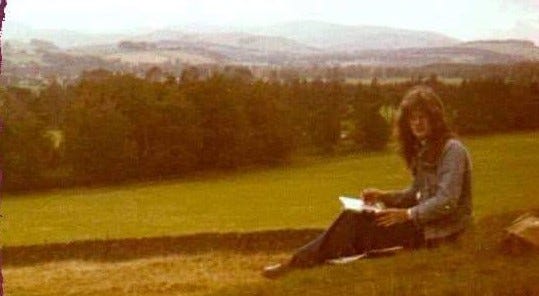
The photograph above is of me at the age of 21 in September 1978, geologically mapping part of the Southern Uplands at West Linton as part of my Combined Science degree.
The job was straightforward in principle. Work out what was happening beneath the ground by examining what could be seen at the surface.
Unfortunately, geology has an inconvenient habit of being covered up.
So I searched the landscape for clues: an exposed rock in a stream, a change in slope, the shape of a hill, fragments of stone in the soil. Each observation might tell me something about the geology hidden beneath our feet.
On this particular day there was another complication. A farmer wouldn’t let me onto his land with my geological hammer.
I suspected at the time that the geological hammer wasn’t really the problem. The long hair probably was. So when my lecturer, Dr Scott visited half way through I explained that my map was going to look like a polo mint, with a hole in the middle. That was when he showed me how to stand outside his farm boundaries and observe, and to look for clues (weak signals) in the topography of the land.
Looking back, that seems remarkably appropriate.
From geological landscapes to human ones
Cut forward to 1998. While working at English Nature I met Dave Snowden, who introduced me to his new ideas that grew out of anthropology and complexity and which profoundly changed the way I approached knowledge (and, dare I say it, life).
One deceptively simple instruction stayed with me: keep field notes.
But there was a discipline to it.
On the right-hand page of the notebook went the emic (phonemic): the words, expressions and meanings of the people themselves – the world, their system, as they described and understood it.
On the left went the etic (phonetic): my observations, connections, questions, and emerging sense of what I hearing and seeing.
The important discipline was not simply which page they went on. It was not allowing my interpretation to become confused with their experience.
Keeping those two things apart is harder than it sounds. Human beings are extraordinarily quick at turning observations into explanations. We see something, recognize a pattern and almost immediately create a story about what it means. Before long, we can forget where the observation ended and our interpretation began.
The field notebook creates a small but important interruption in that process.
This is what I saw. This is what I think it means. They are not the same thing.
Don’t mistake the map you/they are constructing for the landscape you are observing. (the central argument of the field note).
The ethnographer’s notebook
Good ethnographic field notes are therefore much more than a record of events.
They preserve uncertainty. They capture fragments that may initially appear insignificant: an unusual phrase, a contradiction, a silence, a gesture, something everybody seems to know but nobody actually says.
Most importantly, they resist the temptation to tidy reality too early, a concept Dave always delivered with a smile, “avoid premature convergence”. It is all about keeping that thin space, liminal zone, all the possibilities, open,
The ethnographer doesn’t necessarily know which observation will matter. Meaning often appears later, when one fragment is placed alongside another and a pattern begins to emerge.
That idea eventually became important in my work with Participatory Narrative Inquiry and what I now describe as Narrative Ecology. It is also why my PNI reports have so often used landscapes on their covers. They aren’t simply decorative.
I think of the stories within a community or organization as forming a narrative landscape. Some stories are highly visible. Others are almost completely hidden. Some flow together. Some collide. Some disappear beneath the surface only to emerge somewhere else.
And, just like geology, what we can see at the surface is often being shaped by structures we cannot immediately see underneath. It is this ‘making the invisible visible’ that makes all of this so exciting.
Which brings me back to that young geology student sitting, observing and making notes outside a farmer’s field.
At 21, I thought I was learning how to map rocks. Much later, I realized I had also been learning something far more useful:
You don’t understand a landscape by looking for the story you expect to find. You collect the clues, keep observation separate from interpretation, and allow the landscape to reveal the story that connects them.
Perhaps that is what a Narrative Ecologist does.
I stopped mapping geology years ago.
I am not sure I ever stopped mapping landscapes.
[My story, aided and abetted by ChatGPT]


Leave a comment