When the answer is not in the evidence
I realise that I of all people should include more stories in my field notes so here is an old favourite.
I first heard this tale about 24 years ago at Flag Fen Archaeological site just a few miles from where we live at a regular Tuesday evening of ‘meet the archaeologists’.
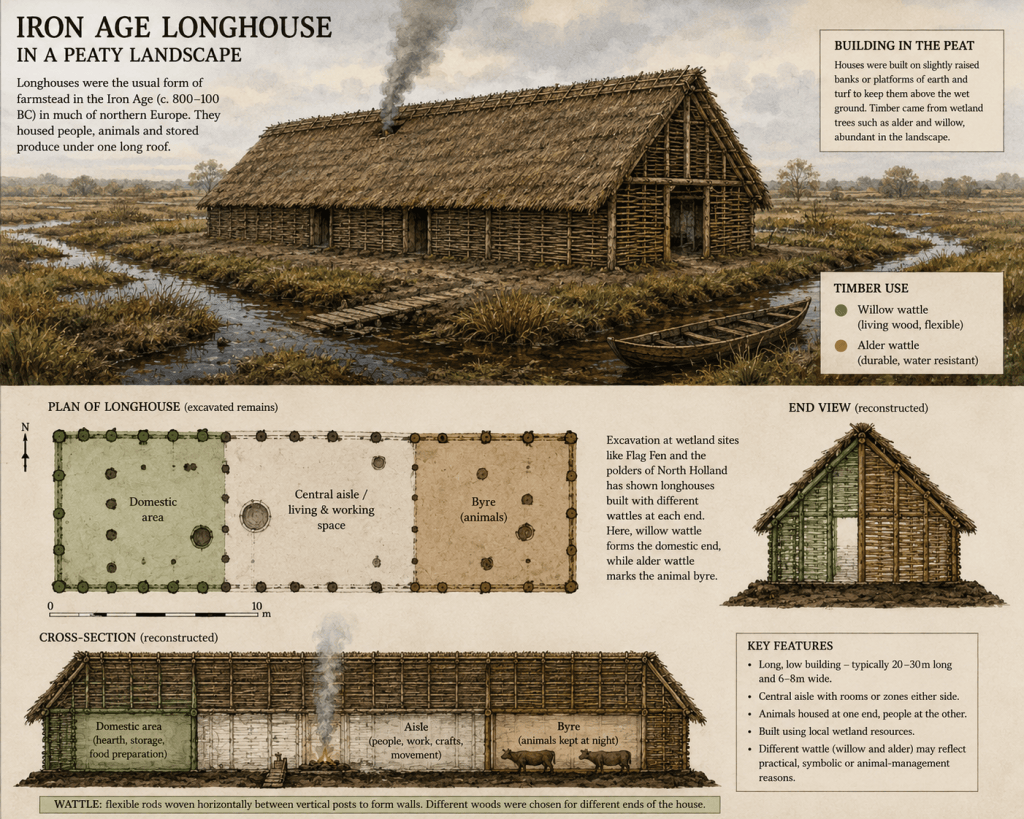
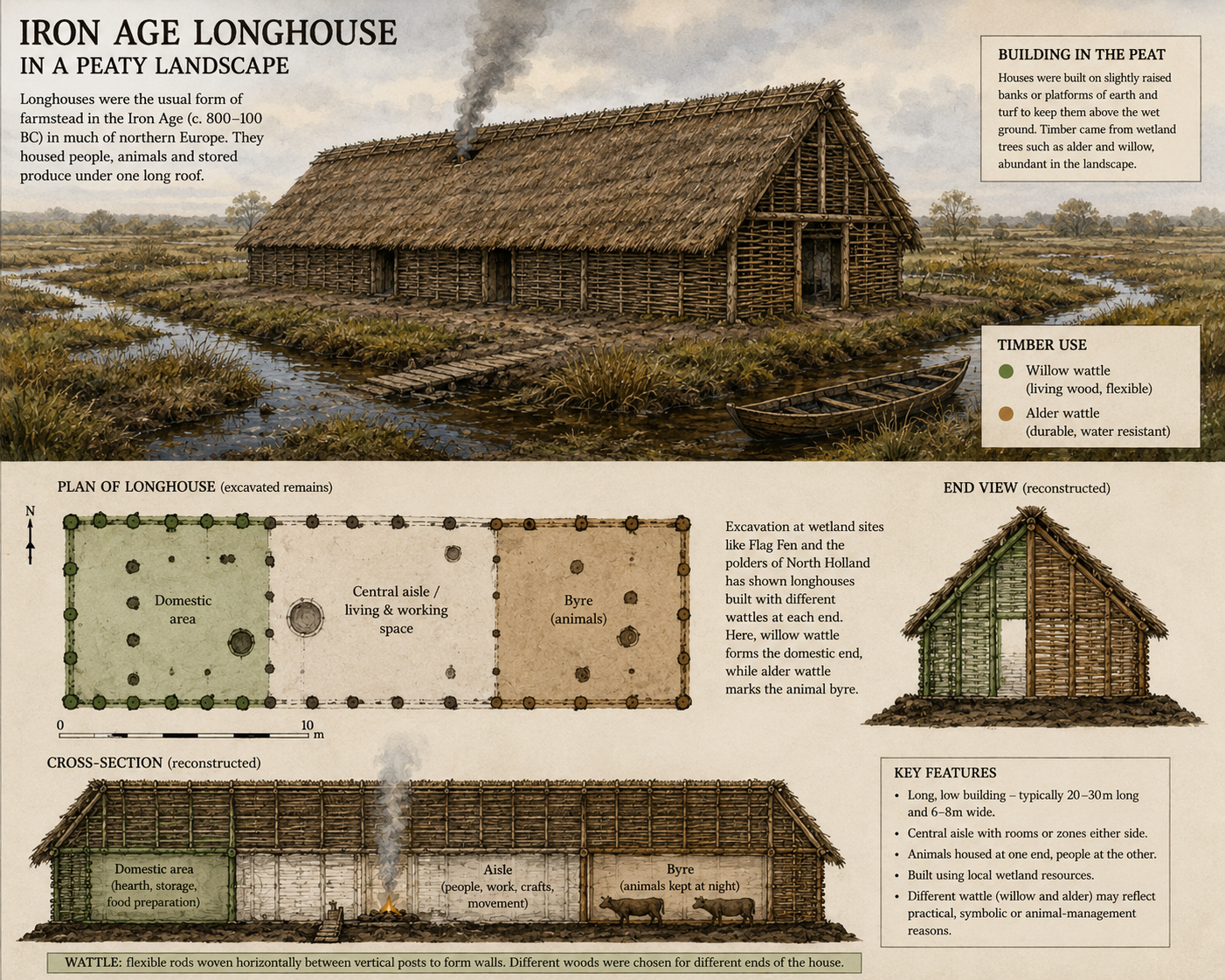
The Story: Maisie Taylor (wife of Francis Taylor of Time Team fame) was a world expert on Iron Age timber and wood (there was little she did not know) and back in 1984 she was invited to the Assendelver Polders, 20 km west-north-west of Amsterdam as they had found the remains of a long house from the early Iron Age.
Wooden posts, representing structural elements, were well preserved by the damp peat as well as occasional lengths of wattle-work and what intrigued them was that the wattle of the walls were of willow and alder. The willow at the people end and the alder end being where the animals slept.
Maisie said both alder and willow would have been prevalent at the time, but she could see no reason why each end had used a different wood. Perhaps it was religious or even status, the willow being the flock wallpaper of the time and the alder the woodchip.
A young archaeological assistant watched this with interest and went home and told her grandmother, whose family had farmed the area for centuries who immediately said “that’s obvious. cattle will stop producing milk if they chew willow which is shooting, the willow in wattle walls stays alive and shoots even after cutting”
The assistant took this new information back to the world’s expert on iron age timber and lots of local archaeology experts and shared this insight. She added that her grandmother predicts they will find a piece of rowan buried beneath the step into the longhouse intended to ward away evil spirits, which to their surprise did prove to be true.
Making Sense:
When I worked at English Nature I used this as a story about how knowledge persisted and was shared orally in the Polders farming community over thousands of years without ever being written down but was not available to the archaeologists with their field notes and case studies.
The archaeologists could establish what had happened. They could identify the species, reconstruct the building and place it within its archaeological context.
But they could not explain why. Why willow here? Why alder there? There was no obvious structural reason. Both trees would have been available in the wet landscape. Neither choice seemed to make architectural sense. And so the question remained open. Perhaps the ancient builders had not been making a structural distinction at all. Perhaps they had been making an ecological distinction.
The archaeologists had been looking at timber. The farmer’s family had been looking at cattle. And the grandmother knew something about the relationship between the two.
That was the story I used to tell when I talked about what I then called knowledge ecology. But I think I understand the story differently now.
The missing knowledge was not missing
The obvious lesson is that traditional knowledge can preserve information that formal disciplines have lost. The archaeologists possessed one kind of knowledge. The farming community possessed another. Neither was necessarily superior. They were looking at different things.
The archaeologist saw Salix and Alnus. The farmer saw a cow. Maisie, the wood specialist saw the properties and availability of timber.
The grandmother saw a consequence. And the young assistant occupied the interesting space between them. She was not herself the source of the knowledge. She was the connection through which knowledge could move.
We often talk about knowledge as though it resides inside people or documents. But sometimes knowledge exists between communities. It is distributed across relationships.
The archaeological record contained one fragment. The living community contained another. The answer emerged only when the fragments were allowed to meet. This is what I now mean by a narrative ecology.
Knowledge is not simply stored. It circulates. It disappears from one place and survives in another. And sometimes a person becomes the bridge that allows two separated fragments to recognise each other.
But there is a problem with the story
There is an even more interesting twist. A few years ago I told this story to some of the newer staff at Natural England at a storytelling training session and someone immediately said “but that’s not true!”. [For context – Natural England was formed by the merger of English nature with the RDS part of what was originally the Ministry of Agriculture and Fisheries, and have a stronger farming related background.]
In fact, the modern evidence complicates it considerably.
Willow is eaten by cattle and other ruminants. Research has investigated willow as tree fodder, and experiments with dairy animals have found no simple suppression of milk production. Willow contains salicin and other plant compounds, and there is evidence of potentially beneficial anti-inflammatory effects.
There is also a substantial ethnoveterinary tradition in Britain in which willow has been deliberately used with cattle, including for inflammation.
And yet the archaeological interpretation itself survives in the literature in a wonderfully cautious form: the different woods may have been intended to keep cattle from nibbling willow bark because of its perceived effect on milk.
That little word — perceived — changes everything. Because now we have three possibilities.
The grandmother may have remembered a genuine piece of husbandry knowledge.
She may have remembered a local belief rather than a physiological fact.
Or the practice may have had another explanation altogether and we cannot simply ask the archaeological evidence to decide between them.
This is where narrative ecology becomes more interesting than knowledge transfer
The conventional knowledge-management story would say:
Archaeologists didn’t know something, local people did and the local knowledge was transferred to the archaeologists. But that is too neat.
What actually happened is more interesting.
There was an unexplained pattern in the archaeological record. A specialist generated a hypothesis. A question travelled through a young practitioner into another knowledge community. An older person supplied a plausible explanation. And the explanation then travelled back into archaeology.
But nobody had the whole truth. The grandmother did not suddenly become an archaeologist. Maisie Taylor did not suddenly become a dairy farmer. The archaeological evidence did not prove the grandmother’s explanation.
Instead, a new possibility entered the system. That is what good sensemaking often does. It does not close uncertainty. It changes the quality of the uncertainty.
Before the grandmother spoke, the different woods were simply an unexplained anomaly. Afterwards, they became a question about animal behaviour, plant chemistry, husbandry, local ecology and cultural memory. The system had acquired another way of seeing itself.
The grandmother was carrying an hypothesis disguised as common sense
This may be the most important part of the story. “That’s obvious” is often what expertise sounds like when it has become deeply embedded in everyday life and the grandmother probably did not experience herself as possessing specialist knowledge.
She simply knew something that people in her world knew and because it was ordinary knowledge, the experience or heuristics of Dave Snowdens ASHEN categories, and it had probably never been written down. This is one of the great weaknesses of formal knowledge systems. They are extraordinarily good at preserving things we have decided are worth preserving. They are much less good at preserving things that communities consider too obvious to record.
The dangerous knowledge is therefore sometimes not the knowledge that has been forgotten. It is the knowledge that nobody thought needed remembering.
The young assistant was the ecological keystone. She is easily overlooked in the story but perhaps she is the most important character.
She moved between worlds. Archaeology on one side. Family memory and farming practice on the other. She was able to recognise that an archaeological puzzle might be an ordinary question somewhere else. That is a very different capability from being an expert. It is the capability of not knowing where knowledge is supposed to live.
The young girl isn’t innovative because she has a brilliant idea. She is innovative because she has access to two worlds that normally don’t talk to one another.
The girl was not the affordance. Her position was. Her position afforded connection, which is very Cynefin: the possibility wasn’t sitting inside her as a capability waiting to be deployed. It emerged from the interaction between person, context, communities and the question.
I increasingly think this is one of the characteristics of a narrative ecologist. A narrative ecologist is not necessarily the person who knows the answer. They notice when an answer may exist somewhere outside the ecosystem currently asking the question.
They notice the gap. They notice the strange connection and, most importantly, they create the conditions in which the connection can be tested.
Perhaps the real archaeological artefact was the conversation
The temptation in archaeology is to think that the artefact is the timber but perhaps the more interesting artefact is the conversation that the timber provoked.
A piece of willow.
A piece of alder.
A puzzling spatial arrangement.
An archaeologist.
A young assistant.
A grandmother.
A farming tradition.
A hypothesis.
And, eventually, another way of seeing the past.
The timber survived for centuries.
But so did something else:
a way of knowing what timber meant.
That is the extraordinary thing about oral knowledge. It does not necessarily preserve propositions. It preserves relationships.
Not: Willow contains X compound and therefore produces Y physiological effect. But: Don’t let the cows get at that, and if you have forgotten why, the instruction can survive for generations after the explanation has disappeared. Archaeology can recover the material trace. Story can recover the relationship. Neither is complete on its own.
The lesson I would now take from the Polders
I used to tell this as a lesson about knowledge transfer. I would now tell it as a lesson about narrative ecology. The question isn’t: “Who has the knowledge?” It is: “Where might the missing relationship still be alive?” and then: “Who or what can connect the places where fragments of that relationship survive?”
That is a different way of thinking. It changes the role of the expert as the expert is no longer necessarily the person with the answer. Sometimes the expert is the person who knows where to look for another way of knowing. [This has interesting implications for TRIZ which I will do a deep dive into in future field notes]
And it changes the role of the community. The community isn’t simply a stakeholder to be consulted after the experts have formulated the problem. It may contain a completely different description of the problem.
The grandmother did not provide “local opinion” to the archaeologists. She potentially changed the space of hypotheses available to them. That is a much more powerful contribution.
And perhaps there is one final irony
We should not be too quick to declare the grandmother correct.
The modern evidence suggests that willow is not simply something that dairy cattle must be protected from. Indeed, willow can be fodder and may have medicinal value. So perhaps the grandmother’s explanation was wrong. But that does not make the story less valuable. It makes it better.
Because narrative ecology isn’t about replacing scientific knowledge with traditional knowledge. Nor is it about romanticizing “indigenous” or “local” wisdom as inherently true.
It is about creating a system in which different ways of knowing can challenge one another.
The archaeologist’s evidence challenges the grandmother.
The grandmother’s memory challenges the archaeologist’s assumptions.
The botanist can challenge both.
The farmer can challenge the botanist.
And somewhere in the resulting conversation, a better question may emerge.
That, perhaps, is the real lesson of the willow and the alder. The purpose of bringing knowledge ecosystems together is not to discover which one is right. It is to discover what becomes thinkable when they meet. And sometimes the person who changes the system most profoundly is not the professor, the archaeologist or the specialist. Sometimes it is the young woman who goes home and asks her grandmother.
“Why would they have done that?”
A good story doesn’t necessarily give us the answer. It changes what questions we are capable of asking.
Different narrative ecologies (living, evolving, adaptive patterns of knowing distributed through people, practices, stories, environments and relationships) can preserve different parts of a phenomenon for very long periods, even when one community has developed sophisticated explanatory knowledge that never reaches another.
Expertise is often deep knowledge of a domain. But phenomena don’t necessarily respect our domains.
What has stayed with me is that Maisie Taylor was not simply an archaeologist who had missed a bit of local knowledge. She was, by any reasonable description, a world expert on timber. If there was something to know about the trees used in the building, how they grew, how they were cut, worked or used, Maisie was precisely the person we would expect to know it, and yet the answer still lay outside her expertise.
That matters, it suggests that expertise does not necessarily fail because an expert lacks knowledge. Sometimes it fails because the phenomenon crosses the boundaries around the knowledge.
The farming community had preserved a relationship between willow, cattle and milk that had remained alive through oral transmission. Somewhere else, science and archaeology had accumulated increasingly sophisticated knowledge about wood. Neither community had lost its knowledge. What had been lost was the connection between them.
The young archaeological assistant was therefore doing something more important than transferring information. She was reconnecting two narrative ecologies that had been separated for centuries.
Perhaps that is one of the things we mean by expertise. Not knowing everything within a domain but knowing when the answer might live somewhere outside the domain.
“The knowledge wasn’t lost. The connection was lost.”


Leave a Reply