Let the ecology tell its story
As I hope I explained, these are field notes, not fully thought out final versions of anything. This is a work in progress which I hope you find interesting but it is primarily for me to get my thoughts and words in order. My standard workshops have an architecture of sorts. Time is most often my biggest constraint and so I rarely get to do a full run of these steps unless in a sandpit situation for which I have been lucky enough to do a few times now.
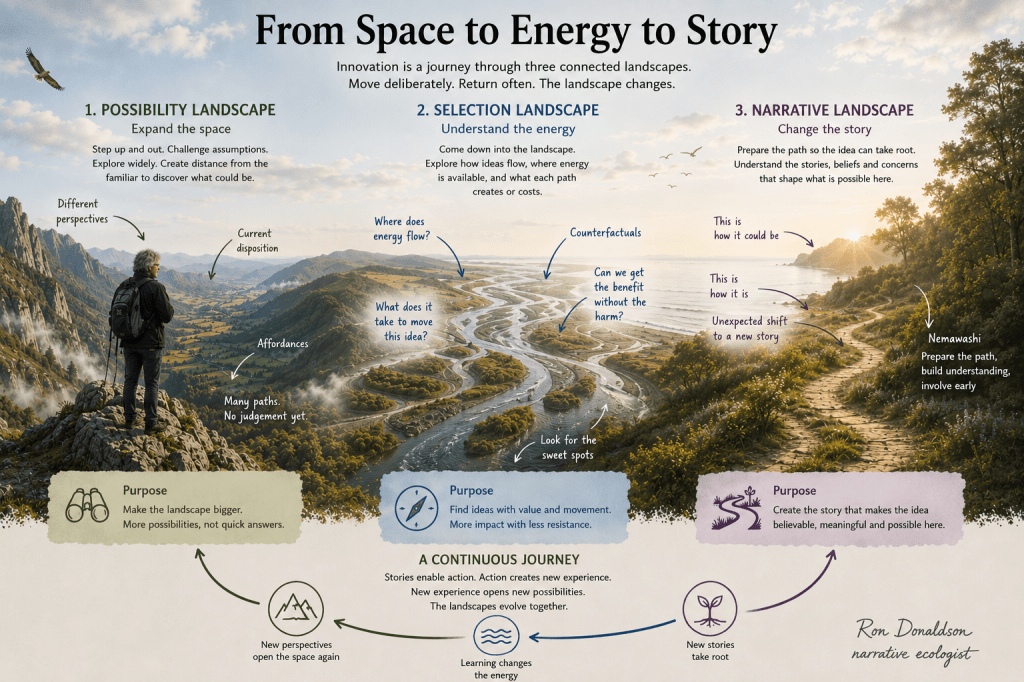
As an example of a developing understanding I present this infographic which, with ChatGPT I attempted to give a simple overview. It is missing this very Orientation Landscape which comes before this but I think it is interesting enough to share as the heart of my approach.
A quick overview of what is coming next:
The complete architecture
1. CONNECT — Community Glue (this was the subject of Field Note # 2)
Create the human ground. Creates connections.
Reveal existing connections and create the conditions for people to listen to one another.
2. ORIENT — Participatory Narrative Inquiry (This Field Note)
Let the system tell its story. creates shared meaning.
Past → Today → Desirable Future
Stories create belonging, reveal perspectives and allow common ground to emerge. Awen begins to swirl.
3. EXPAND — Possibility Landscape
Make the space bigger. creates new options.
Explore what might be possible without prematurely judging it.
4. SELECT — Energy Landscape
Understand what can move. creates movement.
Find possibilities that have an interesting relationship between value, consequence and the energy required to move them.
5. NARRATE — Narrative Landscape
Prepare the path. create a path.
This is how it is → This is how it could be
So lets get started. After we have applied the community glue and before we ask what might be possible, there is a more fundamental question:
Where are we? Not simply geographically or organizationally. Where are we in the story of this particular ecology?
What has brought us here? What is happening now? And, if things were to go well, where might we want to find ourselves ten years from now?
This is the Orientation Landscape. It is not an analysis of the problem. It is not the facilitator’s diagnosis. And it is certainly not the point at which we start proposing solutions.
It is an opportunity for the people who inhabit the ecology to come together, tell its stories and begin to make sense of it for themselves.
First, create the conditions:
This begins with something deliberately simple. Before asking people to examine the ecology they are part of, I use the Community Glue exercise we explored in field note 2.
The hexagons provide a physical way of making connections visible. People discover something about each other and about the networks they already inhabit.
They talk. They move. They find connections they didn’t know were there. The room begins to become something other than a collection of individuals.
This matters because the work that follows depends upon listening. The facilitator’s job is not to tell people what to look for. It is to create the conditions in which they can listen, notice and inquire together.
That distinction is fundamental to the whole approach. Then let the ecology tell its story.
One of the new insights these chats with ChatGPT gave was that it is not simply that the narrative ecologist creates the conditions for stories to be told but, probably far more important, creates a listening space. A safe place to lean forward, open your mind and listen.
The Orientation Landscape uses Participatory Narrative Inquiry. Where participants conduct an inquiry on their own ‘ecology’ involving as much storytelling as possible.
Rather than beginning with a conventional analysis of the problem, participants tell stories around three perspectives:
TODAY
What is happening now?
PAST
How did we get here?
DESIRABLE FUTURE
If we were looking back ten years from now, what would we hope had become true?
These aren’t requests for reports or forecasts. They are invitations to tell stories. And there is an important difference in the way the past is explored.
We work backwards. History has a dangerous tendency to become tidy when we look backwards. We tell ourselves: We did this, which caused that, so we responded by doing this, which eventually produced where we are today.
It makes the past look inevitable. But lived experience is rarely so neat. So rather than constructing a linear history from the distant past towards the present, I always ask people to work backwards from today.
Today ← What happened before this? ← And what came before that?
This creates a different kind of historical inquiry. It leaves room for coincidence, competing interpretations, unintended consequences, missed opportunities, accidents and decisions that made sense at the time. The past becomes less a chain of causes and more a landscape from which the present has emerged.
That distinction matters when we are trying to understand a living ecology.
The future is a direction, not a solution.
The third part of the orientation is the desirable future.
Here I deliberately avoid asking: What should we build? or: What is the solution? Those questions come later.
Instead:
Imagine it is ten years from now and things have gone in a desirable direction. What would be different? What would you notice? What would people experience? What would have become possible? What would you feel?
The future is therefore not a plan. It is a sense of direction. That distinction becomes important later.
We don’t want to constrain the possibility landscape by deciding too early what the solution should look like. We want to know what kind of future the people who inhabit the ecology would like to move towards, while leaving open how that future might be reached.
And because the future has emerged alongside stories of the past and present, it is grounded in the lived experience of the people who will ultimately have to navigate towards it.
Then something changes. The stories are not simply collected. They are told. To the room, if the group is small enough. Or to another group, if there are too many people for everyone to hear everything.
This was an addition I made to the process very early on as an apprentice to Dave Snowden because I noticed something happening when people began to hear one another’s stories.
The energy in the room changed. People laughed. They leaned forward. They listened more deeply.
Someone recognized an experience they had never heard described before. Someone else suddenly understood why another person saw things differently. Connections appeared between stories. The room became quieter in some places and more animated in others.
I came to think of this and describe it as Awen — the spirit of story — as everyone could sense it beginning to emerge and swirl around the room.
I don’t need to explain Awen to participants. Indeed, I don’t want to. What matters is creating the conditions in which people can experience that change for themselves.
The stories have begun to create something between people. The ecology begins to see itself
This is one of the most important things that happens in the whole process. The facilitator doesn’t interpret the stories. There is no hidden exercise in which I am listening for the “real issues” while the participants are talking.
I don’t decide which stories matter. I don’t tell the group what they should notice. The people in the room are the people who inhabit the ecology. They are therefore the people best placed to begin making sense of it.
Through telling and listening, they encounter:
Different perspectives: we don’t all experience this place in the same way.
Shared experience: There are things many of us recognize.
Unexpected connections: I hadn’t realized that was connected to this.
Tensions: We may want different things.
Possibilities: Perhaps there is more common ground here than we thought.
This is why I don’t think of this stage as simply information gathering. It is the beginning of collective sensemaking. The ecology is, in a small but important way, beginning to hear itself.
The facilitator disappears.
There is a paradox at the heart of this approach. The better the facilitation, the less visible the facilitator becomes. I am not there to provide the insight. I am not there to tell people what the ecology means. I am not there to select the important stories. I am not there to steer them towards my preferred future.
My role is to create the conditions in which they can do those things for themselves. The hexagons create connections. The stories create listening. The backward history disrupts the temptation towards neat causality. The sharing of stories creates the conditions for Awen.
The desirable future creates a sense of direction. And then the facilitator gets out of the way. Because the real objective is not for participants to agree with something I have told them. It is for them to reach the point where they can say:
This is our ecology. This is how we have come to be here. This is how we experience it now. This is where we would like to move towards.
And then comes the interesting question.
If this is where we are, and this is the direction we want to move in: What else might be possible?
That is where the next landscape begins. Not with a blank sheet of paper. With a landscape that the participants have already explored, populated with stories, relationships, experiences and a sense of direction.
In the spirit of Participatory Narrative Inquiry please feel free to add a comment that might include ‘what you get’ from this field note. I am always interested in which bit seems the most insightful and how differently people think.
[These posts are also being parallel posted on my new SubStack]
Coming soon: The Possibility Landscape. Which will be the subject of Field Note #4


Leave a comment